
The physiological principle
Human vision is inherently binocular. Our two eyes, spaced an average of 6.5 cm apart (pupillary distance), capture two images of the world from slightly different angles.
The brain merges these two signals to recreate the sensation of depth using two mechanisms:
- Convergence
- Binocular disparity (or parallax)
Convergence
Convergence refers to the inclination of the eyeballs toward a common point.
|
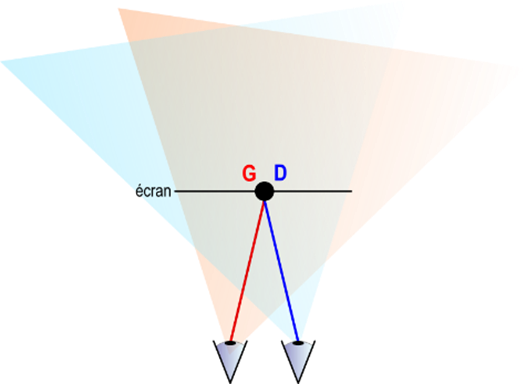
When a single image is projected onto a screen, such as a ball, our eyes converge on the plane of the screen.
The only distance we perceive is that between us and the screen. To disrupt this impression of depth, we need to make our eyes converge on another point.
To do this, let's project two images of this ball, one for each eye. If the images are superimposed, the ball appears at the distance of the screen: there is no depth perception.
|
|
|
|
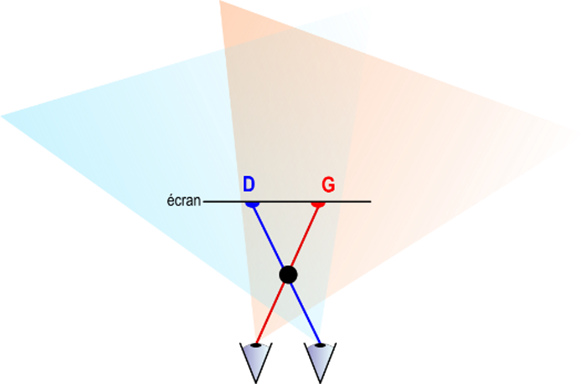
In order for the two balls to appear closer together, our eyes must cross.
So we will cross the images: the image of the ball on the right is shifted to the left.
The image on the left is shifted to the right.
The ball will appear to float in front of the screen. The effect produced is an impression of emergence. |
Binocular disparity (or parallax)
This is the analysis of the horizontal shift between the two images to deduce depth.
|
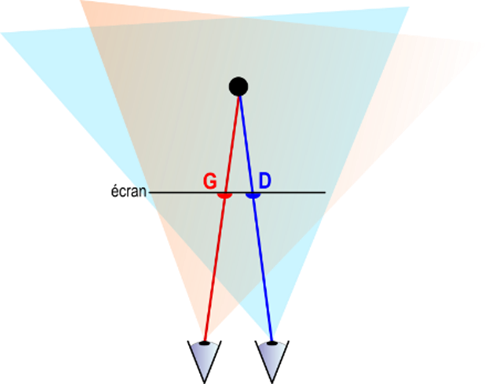
When the gap between the two images reaches the gap between our eyes, they are parallel.
The ball appears to be at infinity, or at least very far away.
The effect produced is an impression of depth. |
|
Relief and Emergence
It is therefore the horizontal shift of objects on the screen that defines their perceived position in space:
- The screen plane: If the two images of the object are perfectly superimposed, our eyes converge on the screen. The object is perceived as “flat.”
- Emergence: If the images are crossed (the image on the right is shifted to the left and vice versa), the eyes converge in front of the screen. The object appears to float between the user and the screen.
- Depth (infinity): When the horizontal shift reaches the interpupillary distance, the visual axes become parallel. The object is perceived as being at infinity.